

Biological Soil Health Assessment
Our Biological Soil Health Assessment provides objective information about the biological condition of the soil, helping land managers establish a biological baseline, monitor changes over time and build historical records that support better-informed management decisions.
Rather than replacing conventional soil analysis, our assessment complements laboratory testing, field observations and agronomic expertise by providing additional insights into the biological processes that drive long-term soil function and resilience.

At the heart of our Biological Soil Health Assessment is Pfeiffer Circular Chromatography, a revolutionary diagnostic technique developed by Dr. Ehrenfried Pfeiffer (1899–1961), one of the pioneers of biological agriculture and a close collaborator of Rudolf Steiner.
For more than 70 years, it has been used around the world as a complementary approach for assessing the biological condition of soils, composts and crops.
Pfeiffer Circular Chromatography it's a unique diagnostic method that captures the overall biological expression of the soil. If we think of soil as a symphony orchestra, what truly matters is not the number of instruments, but whether they are playing in harmony. A healthy soil is defined by functional balance—the interaction of thousands of biological processes, rather than simply the abundance of individual microbial populations.
Pfeiffer Circular Chromatography captures this biological harmony, revealing whether the living processes that sustain your soil are functioning together as a balanced system—or beginning to fall out of balance.
The resulting chromatogram provides trained professionals with a visual representation of your soil's biological condition, helping evaluate biological activity, humification processes and overall soil functionality

A POWERFUL TOOL FOR BETTER DECISIONS
Establish a Biological Baseline: Understand the current biological condition of your soil and establish a clear starting point for future management decisions.
Monitor Changes Over Time: Track how your farming practices influence the biological health and functionality of your soil over time.
Evaluate Management Impact: Assess how cultivation practices, biological products, organic amendments and conventional agricultural inputs affect your soil's biological functionality.
Evaluate Input Performance: Understand the biological response of your soil to fertilisers, biological products, organic amendments and other agricultural inputs.
Support Better Decisions: Use objective biological information to improve soil function, strengthen resilience and support more informed management decisions.

Understanding soil as a living system
For decades, agricultural diagnostics focused primarily on chemical analysis.
But modern agriculture increasingly recognizes that soil is far more than chemistry alone, it is a living, dynamic and highly complex biological system.
Pfeiffer Chromatography is rapidly attracting international attention as one of the most fascinating diagnostic tools for understanding soil functionality, biological activity, humification processes and overall system balance.


Pfeiffer Chromatography is not just a test, it is a window into the living system beneath our feet.
It helps us understand soil as a interconnected, dinamyc and self-regulating organism.
It Provides the most complete picture of your soil’s functionality.


WHY ASSESS SOIL HEALTH?


Pfeiffer Circular Chromatography is a sensitive, cost-effective method that provides a visual “fingerprint” of the soil that reflects the activity of the living component and the overall state of the system.


REVEALS BIOLOGICAL ACTIVITY
Patterns reflect microbial processes and the metabolic activity occurring in the soil.

Captures the interaction between biological, chemical and physical components.
INTEGRATES MULTIPLE DIMENSIONS

COMPLEMENTS CONVENTIONAL SOIL TESTS
Adds the missing biological dimension that traditional analysis alone cannot detect.

SUPPORT BETTER DECISIONS
Helps identify trends, imbalances and opportunities to improve soil function and crop performance.

SOIL IS DINAMIC
SOIL IS BIOLOGY
SOIL IS ALIVE
Biological activity drives nutrient cycling, structure formation, resilience and plant health. To understand soil, we need to look beyond what chemical tests can see.


MORE POWERFUL TOGETHER: AN INTEGRATED APPROACH
Soil health is better understood when multiple sources of information are combined.
We integrate Soil Chromatography with complementary tools for a complete view of your system.

SOIL CHROMATOGRAPHY

Provides deeper insight into the underlying factors influencing soil performance and crop response.
Supports more strategic decision-making through a broader understanding of soil functional dynamics.

PLANT HEALTH ASSESSMENT
Plant Health Assessment is designed to detect those signs earlier, rather than relying exclusively on reacting only after damage has already occurred.

DRONE MULTISPECTRAL IMAGERY


More than just drone operators, we bring agricultural understanding to interpret what your crops are showing and support better decisions in your operation.
INTEGRATED HEALTHY SYSTEM

A comprehensive interpretation of soil biology, plant condition and field variability for better decisions and sustainable outcomes.


Chromatography patterns can give insight into humification processes, helping us understand how carbon is cycled and stored in the soil.
Humus is both a product and a driver of soil biological activity. It improves structure, enhances water and nutrient holding capacity, and provides a stable environment for microorganisms. For this reason, Understanding whether the soil is actively forming humus or whether this process has been disrupted, is therefore essential for evaluating long-term soil function and system resilience.


HOW THE ASSESSMENT WORKS


FIELD SAMPLING
Soil samples are collected using proper protocols to ensure representativeness and integrity.
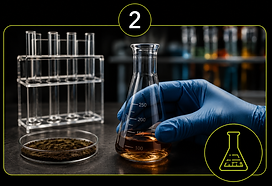
LABORATORY PROCESSING
Samples are prepared using Pfeiffer Circular Soil Chromatography techniques.

CHROMATOGRAM DEVELOPMENT
The chromatogram reveals unique patterns that reflect the soil’s biological and biochemical activity.

INTERPRETATION & ANALYSIS
Patterns are analized in the context of biological, chemical, physical and agronomic information.

DETAILED REPORT
You receive a comprehensive report with insights and practical recommendations to support better decisions

Scientific Background
Pfeiffer Circular Soil Chromatography has been investigated in multiple scientific studies conducted across different countries, farming systems and soil types around the world.
These studies demonstrate significant relationships between chromatographic patterns and key indicators of soil fertility, biological activity and soil health. This body of science supports its use as a powerful diagnostic tool within integrated soil health assessment strategies.


SCIENTIFIC VALIDATION


Kokornaczyk et al. (2017)
Analysis of soils by means of Pfeiffer’s circular chromatography test and comparison to chemical analysis results
"The study demonstrated significant relationships between Soil Chromatography patterns and key soil fertility indicators".


Poland

Research Summary:
Title:

Hernández-Rodríguez et al. (2021)
"The research validated that Soil Chromatography can be used to estimate soil fertility in practical agricultural environments".
Mexico

Patterns for Estimating Soil Fertility Using Pfeiffer’s Chromatography
Title:
Research Summary:

Brazil
Sánchez-Navarro et al. (2020)
Evaluating Pfeiffer Chromatography for Its Validation as an Indicator of Soil Quality
Title:
Research Summary:
"The study evaluated Soil Chromatography across multiple production systems and supported its use as a valuable soil quality assessment tool".

The studies presented above represent a selection of the published scientific literature currently available on Pfeiffer Circular Chromatography. Research into this technique continues to grow, with new studies contributing to a better understanding of its potential as a complementary tool for biological soil assessment.
